Subterranean Homesick Alien
I'm scared of driverless cars

“It was nice talking to you,” I say to Nick as I exit his black Escalade at 10 p.m. on a Friday night.
Nick is the driver for the car service that took me from LAX to my brother’s house. The ride took roughly 50 minutes.
When I got into Nick’s car, he asked me if I wanted quiet or not. I told him music was fine. We make small talk as we exit LAX. Not only had I just exited a four-hour flight in which I talked to no one, but I was recalling that I hadn’t had an actual in-person conversation with another human since I dropped my kids off at school this morning. Fourteen hours without a substantial conversation.
I am effectively a professional car rider at this point. On my weeks without the kids, I pretty much uber around Memphis every Friday and Saturday night, bouncing around midtown Memphis bars and friends’ places, stopping by my local dive bar on the way home, walking the remaining two miles to my house to end the night. I can tell within one minute whether the driver prefers to talk or be quiet, and vice versa.
Nick and I make small talk. We discuss:
LAX traffic
If he has any more rides tonight (he does, at midnight, at the private airport in Van Nuys)
Where I’m from (Memphis)
What I’m doing here (visiting my brother, driving to Big Sur)
What I’ve done here previously that I enjoyed (I highly recommended Joshua Tree)
From that Joshua Tree conversation, we discuss Coachella, which we both agree it sounds awful to be stuck in the desert with exorbitant hotel prices, ticket fees, and long traffic lines. I mention I’ve always wanted to go to Coachella, just once, but it will probably be like my Bonnaroo experience in my early 20s, when I went twice and vowed to never go again.1
“Yeah, I’d go to Coachella in my 20s,” Nick responds.2
Slowly, the conversation becomes more personal. We discuss our kids. I have three of them, ages 8, 10 and 12. Nick has a 3-year-old and 9-year-old. We discuss his kids age gaps versus how I love the closeness in my kids’ ages now, but it was hard when I had three in daycare and two in diapers. Nick mentions his 9-year-old girl sometimes gets jealous of the baby, so he has to make sure to give her the same amount of attention.
“They will always fight for attention,” I quip.
We find out increasingly more about each other. A 50-minute uninterrupted conversation is rare these days.
Dry Spell by Kacey Musgraves plays in the background as we make our way through downtown LA.
“I still need to write my Dry Spell thoughts,” I think to myself, as the conversation turns again, this time, not to kids, but to the rest of our families.
“Do you have a big family?” he asks.
I mention my sister and mom back in Memphis, and he knows about my kids now, and obviously that I have a brother here in California that I’m visiting.
“That’s pretty much it,” I say. “My father died in 2022,” I awkwardly add.
It’s been almost four years, and I never know what you are or aren’t supposed to say. I never know if mentioning a dead relative creates tension, or if not mentioning my father at all just leaves a puzzle piece missing in the other person’s brain.
“I’m sorry,” he says.
By now, I know that Nick is from Russia, and he’s been here 20+ years thanks to the green card lottery his mom won, and his brothers are here too, and he has a wife and two kids, and that the war in Russia has kept him from visiting his father back home for almost four years now, but I don’t have one puzzle piece myself. He hasn’t mentioned his mom.
“What about your mom?” I ask.
“She died in 2016,” he says.
“I’m sorry,” I start. “It’s been almost four years since my dad died, and I keep thinking it will get easier. Like, when it first happened, I was incredibly sad, but now, I don’t know, I guess you realize this will just be with you forever.”
“It was tough for me for the first three years,” Nick adds. “But I went to therapy and learned to live with it.”
“I heard a quote that says, ‘It doesn’t get easy, but it gets easier.’” I add.
We are 15 minutes from my brother’s house. Radiohead’s Subterranean Homesick Alien is playing now.
“I think I just get overwhelmed that I will always have this with me now,” I continue. “Like, for the rest of my life, whether it’s ten years, or forty, or whatever, there will just be times I miss my father.”
Nick understands.
We talk about our respective parents’ deaths. My father, a car accident. His mother, alcoholism.
We broach survivor’s guilt, about whether if he stayed in Russia he could’ve saved his mom. I talk about the day of my dad’s wreck, about which things I could’ve done differently. A ten-minute exchange on death, on grief, on whether dying over a long period of time or in a day is preferred, ends with us agreeing on the only platitude that can sum it up, “when it’s your time, it’s your time.”
The conversation weaves deeper into whether we are spiritual.
“It was easy to be an atheist when I was younger. It’s a lot harder when you miss someone and want to see them again,” I say.
“Same,” Nick says.
We talk about whether reincarnation is real, about how uncanny it is that his daughter, born shortly after his mom died, looks exactly like her as a baby as well. I talk about the traits that my son has with dead relatives on mom’s side that I never even got a chance to meet.
In the middle of this, with the eerie Radiohead song scoring our drive, I think about an article I read on the plane, about Oracle laying off their workforce to invest more in AI data centers, or about Meta laying off people, and I wonder, darkly, about when driverless cars will be the default3, and I’ll just be sitting in the back with automation paving the way, and this conversation with a stranger will never occur, and I’ll never know about Nick or his kids or his mom or his dad back in Russia that lives in the countryside and grows berries and fishes every day, and we’ll never have had weird conversations about how you get more spiritual as you get older, and you won’t share regrets about your dead parents, and you won’t exchange little stories about music festivals, and none of this, none of it will happen anymore, and you will just be a human in a car playing on an iPhone and there’s one less connection point and one less job and a little less of everything.
Nick and I talked the entire 50-minute drive, me not looking at my phone once, other than to write down two simple items to remember.
On my “Notes” app, I quickly typed Dry Spell and Subterranean Homesick Alien. I wanted to remember the conversation. That’s all I needed.
As he pulls up to my brother’s house, Nick ends the conversation by saying he is going to call his dad this evening, which brings me joy in a way I can’t quite explain, like it validated our entire conversation, it meant something.
We exit the car and get my luggage out of the back. I awkwardly make eye contact with Nick, us having had this entire conversation with me in the back of the car, me only seeing the back of his head as we talked.
I look him in the eye and sheepishly say, “It was nice talking to you.”
He returns the same awkward acknowledgement.
It was just a 50-minute car ride. It was just a driver and a passenger that will probably never talk again. Yet, in that car ride, I met someone like me, someone living in California driving cars, someone from Russia with worries about his aging father back home, someone with grief about his dead mother, someone with kids and brothers and music festivals and an entire life, just like mine.
I met him, and I knew him, and maybe I’d never meet him again.
In the future, with the driverless cars, I’ll never meet him at all.
I lie and say the same thing every time I leave New Orleans and Las Vegas.
Nick suggests a Huntington Beach electronic music festival instead.
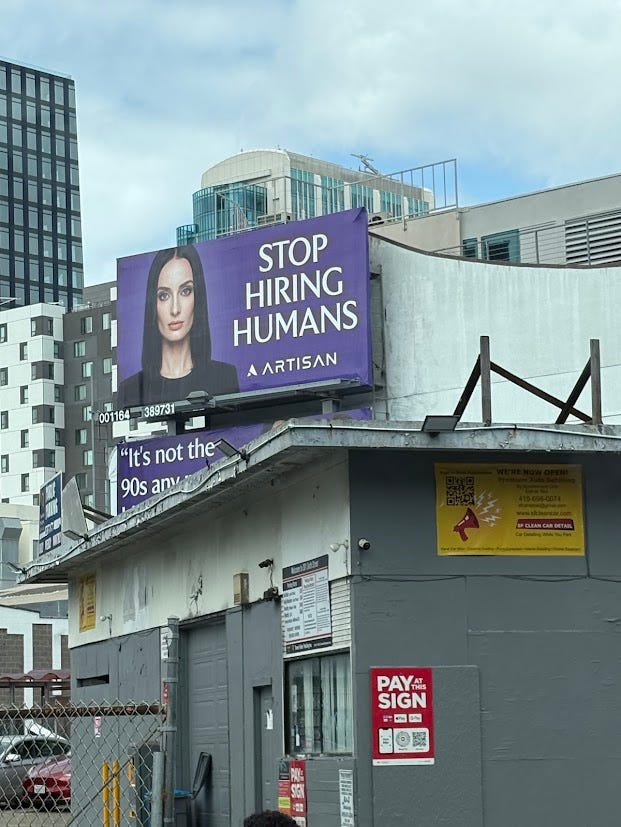
I saw an ad in San Francisco two days after my car ride with Nick that says, “Stop Hiring Humans.”